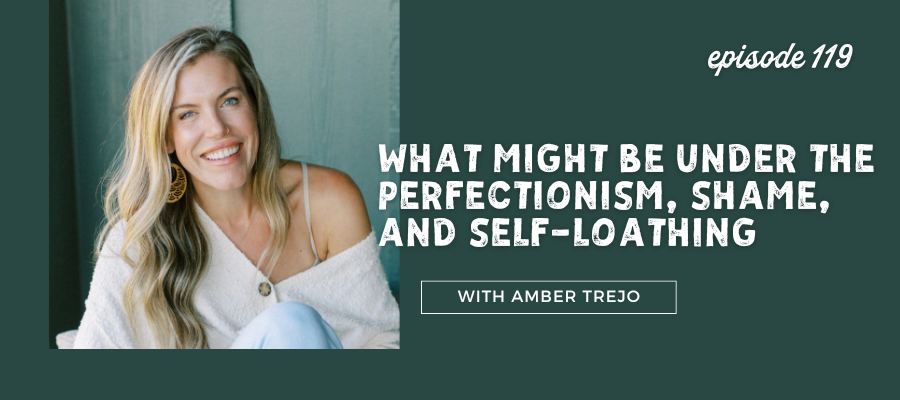
What Might Be Under the Perfectionism, Shame, and Self-Loathing with Amber Trejo [episode 119]
Listen to What Might Be Under the Perfectionism, Shame, and Self-Loathing with Amber Trejo on: Apple Podcasts | Spotify | your platform of choice
I’m honored to welcome Amber Trejo to the podcast today!
From the moment I found Amber’s work online, I knew this conversation needed to happen. Her voice, her honesty, and the way she talks about trauma with so much clarity and compassion immediately resonated with me.
Amber’s own journey hasn’t been linear or easy; she returned to school while pregnant and built her private practice while raising three kids. Along the way, Amber found language and understanding for something that had shaped her life for a long time: complex trauma.
In today’s episode, we’re talking about what might be under the perfectionism, shame, and self-loathing. Amber explains how complex trauma often forms when there was never a true baseline of safety growing up. Unlike a single traumatic event, complex trauma becomes woven into how we relate to ourselves, our relationships, our work, and our everyday lives.
We also dive into parenting, and while it can be painful to realize we might hurt our kids, the repair matters FAR more than perfection. Most of us never saw healthy repair modeled growing up, so of course, it feels uncomfortable and scary now!
Healing from complex trauma and things like perfectionism, shame, and self-loathing doesn’t start with “being better,” it starts with awareness, curiosity, and support. Whether that’s therapy, learning, or simply beginning to ask yourself gentler questions, please know you are not broken, and you are NOT alone!
Meet Amber:
Amber Trejo is a licensed marriage and family therapist who specializes in complex trauma and attachment. She owns a private practice in Indianapolis. She’s also a wife and mom to 3 boys in her own journey to heal from childhood trauma and break the cycle.
In this episode, What Might Be Under the Perfectionism, Shame, and Self-Loathing with Amber Trejo, we cover:
- Amber’s journey into understanding & working with complex trauma
- What complex trauma (C-PTSD) is + how growing up without a baseline of safety impacts the nervous system
- The key difference between PTSD and complex trauma
- How emotional neglect often goes unrecognized, even in childhoods that felt “good”
- Why shame is central to complex trauma + how it often shows up
- How complex trauma affects relationships, conflict & nervous system capacity
- Why repair matters more than perfection in parenting
- How to support yourself + loved ones when navigating complex trauma
Resources & Links:
- You Can Heal Your Life by Louise Hay
- Schedule a free consult and see if 1:1 Good Movement Guidance is right for you
- Check out my merch shop
- Join the waitlist for the Good Movement Collective
- Good Movement music by: Aaron Espe
- Podcast produced by: Jill Carr Podcasting
Connect with Amber:
- Follow on Instagram @integrativetraumatherapist
- Connect on Facebook
- Follow on TikTok
- Check out her website
- Send her an email at ambie0406@gmail.com
Connect with Terryn:
- Follow on Instagram @terryn.drieling
- Check out my website
- Send me an email at terryn@terryndrieling.com
Related Episodes:
- Episode 84: Apologies Aren’t Weak – They’re Repair
- Episode 92: Doing the Work for You: Matt Gasseling on Healing, Fatherhood, and Finding Self-Worth
- Episode 95: “Do I Really Need This Right Now?” — On Waiting for a Crisis to Seek Help
- Episode 93: Family Dynamics and Emotional Healing with Paige Dulaney
More about the Good Movement Draws Good Movement podcast:
In stockmanship (the art and science of handling cattle in a safe, effective, low-stress manner), we have this phrase . . . good movement draws good movement.
It’s this thing that happens when we ask a small group of cattle, maybe a cow or a pair, to move out in a certain direction, and their movement draws the whole herd into moving in the same direction.
Good movement happens when we approach the cattle with a positive attitude, read and really listen to what they’re telling us, and communicate accordingly.
We don’t approach the aware, flighty cattle the same as we do the tame, docile cattle. We adjust ourselves, our energy, and our approach, and we communicate with each other differently.
These adjustments help us effectively draw good movement from each, which then draws good movement from the herd. But it starts with us.
The same is true for humans. Good movement starts with us.
Welcome to Good Movement Draws Good Movement, the podcast where farmers, ranchers, and rural folks can grow relationally through awareness, understanding, and effective communication.
Hey, it’s me – T. I’m your host, and I, along with my guests, will be covering topics related to drawing good movement – things like self and social awareness, brain science, positive psychology, extending grace, and so much more.
We’ll share tools that can help you understand why you are the way you are, why others are the way they are, and how you can use that to step out of self-told lies with grace and compassion to draw good movement in conversations, relationships, and life in rural America.
Tune in every Tuesday, and make sure to hit subscribe so you never miss an episode! Let’s go draw good movement!