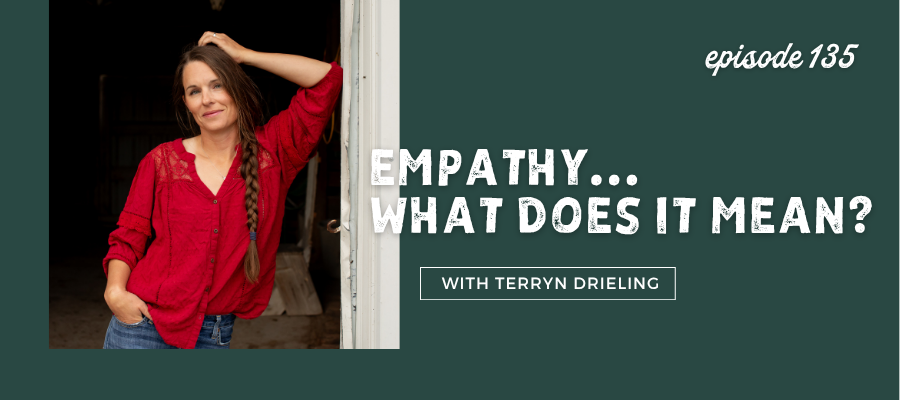
Empathy… What Does It Mean? [episode 135]
Listen to Empathy… What Does It Mean? on: Apple Podcasts | Spotify | your platform of choice
Empathy is often talked about like it’s automatically a good thing. But honestly, empathy can be both a superpower and something that quietly wears us down when we aren’t intentional with it.
As someone who has always felt deeply for other people, I’ve had to learn the difference between holding space for someone and trying to carry what was never mine to carry in the first place.
In today’s episode, I’m talking about empathy and what it really means. Empathy isn’t fixing, rescuing, or processing emotions for someone else. It’s about being able to truly see, hear, AND understand what another person is experiencing.
My own empathy used to lead me into taking on other people’s emotions as my own. Thankfully, inner work helped me recognize where healthy empathy ends and emotional over-responsibility begins.
We can cultivate healthier empathy in our own lives by exposing ourselves to different people and perspectives, asking more honest questions, and learning to second-guess the stories our brains automatically create about other people.
When people feel seen, heard, and safe, there’s less reactivity, deeper connection, and ultimately, more good movement!
If you’re ready to dive deeper and do the “inner work” I talk about here often, I’d love to connect with you. Schedule a free 30-minute call with me, and let’s talk about 1:1 Good Movement Guidance. Don’t forget to mention “castpod” when you book to receive 10% off!
In this episode, Empathy… What Does It Mean?, I cover:
- What empathy actually is (and what it isn’t)
- Why empathy can feel both beautiful and exhausting
- The difference between supporting someone vs. carrying their emotions
- How empathy can become unhealthy without self-awareness
- What the “hold the herd” analogy entails
- Why emotional safety creates a stronger connection
- How exposure to different perspectives helps grow empathy
- The importance of asking honest questions
- Why we should second-guess the stories we create about others
- Learning to sort what’s yours to feel and what isn’t
Resources & Links:
- Schedule a free consult and see if 1:1 Good Movement Guidance is right for you
- Check out my merch shop
- Join the waitlist for the Good Movement Collective
- Good Movement music by: Aaron Espe
- Podcast produced by: Jill Carr Podcasting
Connect with Terryn:
- Follow on Instagram @terryn.drieling
- Check out my website
- Send me an email at terryn@terryndrieling.com
Related Episodes:
- Episode 18: Talking Curiosity and Kindness with My Mother In-Law
- Episode 33: What Happens When Honest Questions Are Met with Resistance?
- Episode 128: The Only Thing for Certain Is That We’re All Human
- Episode 129: Living Through the Largest Fire in Nebraska History
More about the Good Movement Draws Good Movement podcast:
In stockmanship (the art and science of handling cattle in a safe, effective, low-stress manner), we have this phrase . . . good movement draws good movement.
It’s this thing that happens when we ask a small group of cattle, maybe a cow or a pair, to move out in a certain direction, and their movement draws the whole herd into moving in the same direction.
Good movement happens when we approach the cattle with a positive attitude, read and really listen to what they’re telling us, and communicate accordingly.
We don’t approach the aware, flighty cattle the same as we do the tame, docile cattle. We adjust ourselves, our energy, and our approach, and we communicate with each other differently.
These adjustments help us effectively draw good movement from each, which then draws good movement from the herd. But it starts with us.
The same is true for humans. Good movement starts with us.
Welcome to Good Movement Draws Good Movement, the podcast where farmers, ranchers, and rural folks can grow relationally through awareness, understanding, and effective communication.
Hey, it’s me – T. I’m your host, and I, along with my guests, will be covering topics related to drawing good movement – things like self and social awareness, brain science, positive psychology, extending grace, and so much more.
We’ll share tools that can help you understand why you are the way you are, why others are the way they are, and how you can use that to step out of self-told lies with grace and compassion to draw good movement in conversations, relationships, and life in rural America.
Tune in every Tuesday, and make sure to hit subscribe so you never miss an episode! Let’s go draw good movement!