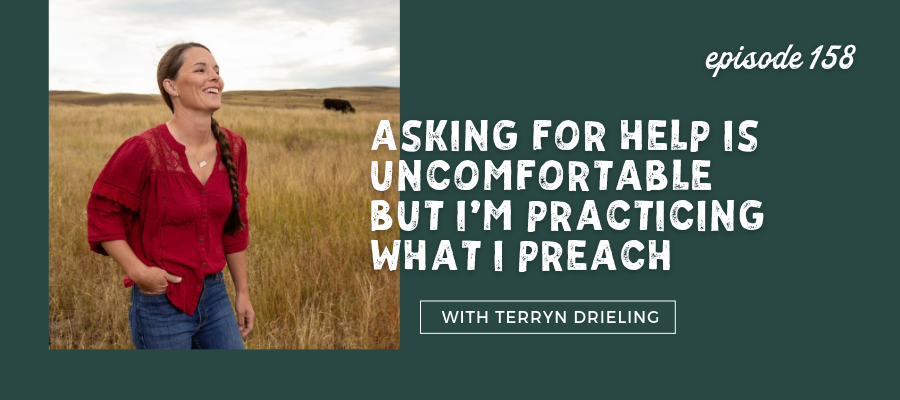
Asking for Help Is Uncomfortable but I’m Practicing What I Preach [episode 158]
Listen to Asking for Help Is Uncomfortable but I’m Practicing What I Preach on: Apple Podcasts | Spotify | your platform of choice
If you’ve listened to this podcast for any length of time, you’ve probably heard me encourage people to ask for help when they need it. But when it comes to asking for help myself? I’m still very much a work in progress.
In today’s episode, I’m talking about why asking for help is comfortable + why I’m practicing what I preach. A couple of weeks ago, I found myself in a situation where I needed to take my own advice, even though doing so felt very uncomfortable.
I love this podcast and the opportunity it gives me to use my voice, share my experiences, and help others feel seen and heard. I’m also passionate about disrupting the way we view mental and emotional well-being in rural spaces.
The reality is, though, keeping this podcast going comes with expenses. With finances getting tight, I was facing the very REAL possibility of having to put it on pause. So, I did something that wasn’t easy for me: I reached out to my email community and asked for help.
Honestly? The love and support I’ve received have been overwhelming (in the best possible way)!
There are so many ways you can support this podcast, and every single one makes a difference. Thank you for being here, listening, sharing, AND helping me continue these important conversations about mental and emotional well-being in rural spaces. I’m so incredibly grateful for you!!
In this episode, Asking for Help Is Uncomfortable but I’m Practicing What I Preach, I cover:
- Why asking for help is something I’m still learning to practice myself
- The financial challenges threatening the future of this podcast
- Choosing to be vulnerable and ask my community for support
- The overwhelming gratitude I’ve felt from the response
- How sharing, reviewing & financially supporting the podcast makes a difference
- Remembering that we’re NOT meant to carry everything alone
Resources & Links:
- Rate and review the cast-pod on your preferred podcast player
- Share your favorite episodes on social media or by word of mouth
- Make a one-time donation, any amount of your choosing, via Venmo @Terryn-Drieling
- Become a monthly supporter, contributing two, five, ten, or twenty dollars a month
- Join the movement
- Learn more about Balance Point
- Schedule a free consult and see if 1:1 Good Movement Guidance is right for you – mention “castpod” when you book to receive 10% off!
- Check out my merch shop
- Join the waitlist for the Good Movement Collective
- Good Movement music by: Aaron Espe
- Podcast produced by: Jill Carr Podcasting
Connect with Terryn:
- Follow on Instagram @terryn.drieling
- Check out my website
- Send me an email at terryn@terryndrieling.com
Related Episodes:
- Episode 95: “Do I Really Need This Right Now?” — On Waiting for a Crisis to Seek Help
- Episode 116: The Beliefs That Keep Us from Asking for Help
- Episode 134: How to Help Someone Who Is Grieving or Going Through a Lot
More about the Good Movement Draws Good Movement podcast:
In stockmanship (the art and science of handling cattle in a safe, effective, low-stress manner), we have this phrase . . . good movement draws good movement.
It’s this thing that happens when we ask a small group of cattle, maybe a cow or a pair, to move out in a certain direction, and their movement draws the whole herd into moving in the same direction.
Good movement happens when we approach the cattle with a positive attitude, read and really listen to what they’re telling us, and communicate accordingly.
We don’t approach the aware, flighty cattle the same as we do the tame, docile cattle. We adjust ourselves, our energy, and our approach, and we communicate with each other differently.
These adjustments help us effectively draw good movement from each, which then draws good movement from the herd. But it starts with us.
The same is true for humans. Good movement starts with us.
Welcome to Good Movement Draws Good Movement, the podcast where farmers, ranchers, and rural folks can grow relationally through awareness, understanding, and effective communication.
Hey, it’s me – T. I’m your host, and I, along with my guests, will be covering topics related to drawing good movement – things like self and social awareness, brain science, positive psychology, extending grace, and so much more.
We’ll share tools that can help you understand why you are the way you are, why others are the way they are, and how you can use that to step out of self-told lies with grace and compassion to draw good movement in conversations, relationships, and life in rural America.
Tune in every Tuesday, and make sure to hit subscribe so you never miss an episode! Let’s go draw good movement!