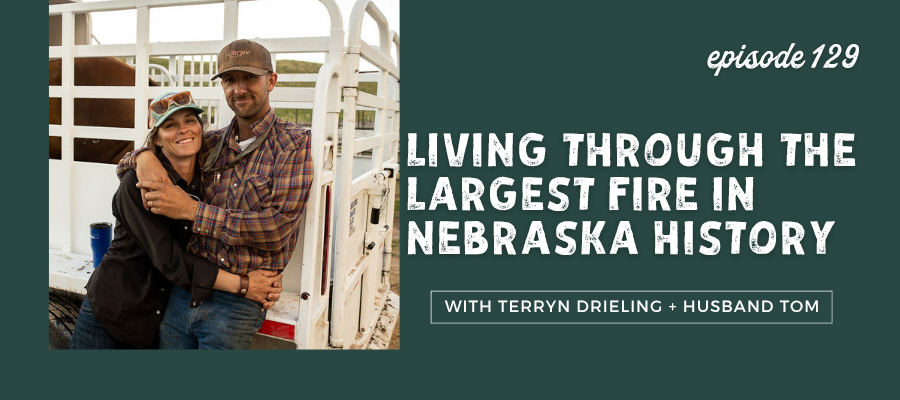
Living Through the Largest Fire in Nebraska History [episode 129]
Listen to Living Through the Largest Fire in Nebraska History on: Apple Podcasts | Spotify | your platform of choice
This episode is a little different, and honestly, a little heavier.
In today’s episode, Tom and I are sharing what it’s like living through the largest fire in Nebraska history. This isn’t a polished or perfectly processed story. It’s still super fresh, and in many ways, we’re still IN it.
Over the course of a few days, everything shifted quickly. What started as concern quickly turned into evacuation and long days of uncertainty. All of that turned into the very REAL possibility of losing not just land, but livelihood, animals, and a way of life that runs deep in this part of the country.
While there have been conversations online about how “the grass will grow back” or how fire can be regenerative, those perspectives often miss the human side of what people are walking through in the present moment.
Tom and I have had to divide and handle what needed to be done. He’s been on the front lines for a lot of it, while the kids and I have stepped away, not knowing what we’d come back to.
This conversation isn’t about tying things up in a neat bow. We want to give an honest look into an experience that SO many in our state have been living, and also, create space for both gratitude and grief to exist at the same time.
In this episode, Living Through the Largest Fire in Nebraska History, we cover:
- The rapid shift from awareness to evacuation as the fires escalated
- What those days looked like in real time
- The reality of protecting animals, land, and livelihood under pressure
- Experiencing the fire from 2 perspectives
- The emotional weight of leaving home without knowing what you’ll return to
- The physical & mental toll of long days on the front lines
- Why “it will grow back” overlooks the real human impact
- Holding both gratitude AND grief at the same time
- The adrenaline response + what happens when it wears off
- Processing an experience that’s still fresh + the importance of empathy in crisis
Resources & Links:
- Schedule a free consult and see if 1:1 Good Movement Guidance is right for you
- Check out my merch shop
- Join the waitlist for the Good Movement Collective
- Good Movement music by: Aaron Espe
- Podcast produced by: Jill Carr Podcasting
Connect with Terryn:
- Follow on Instagram @terryn.drieling
- Check out my website
- Send me an email at terryn@terryndrieling.com
Related Episodes:
- Episode 70: How We’ve Navigated Expectations in Ranch Life and Marriage with Tom
- Episode 97: Cows, Kids, and Communication Gaps with Tom
- Episode 115: The Growing Pains of Boundaries, Help, and Working Together with Tom
- Episode 128: The Only Thing for Certain Is That We’re All Human
More about the Good Movement Draws Good Movement podcast:
In stockmanship (the art and science of handling cattle in a safe, effective, low-stress manner), we have this phrase . . . good movement draws good movement.
It’s this thing that happens when we ask a small group of cattle, maybe a cow or a pair, to move out in a certain direction, and their movement draws the whole herd into moving in the same direction.
Good movement happens when we approach the cattle with a positive attitude, read and really listen to what they’re telling us, and communicate accordingly.
We don’t approach the aware, flighty cattle the same as we do the tame, docile cattle. We adjust ourselves, our energy, and our approach, and we communicate with each other differently.
These adjustments help us effectively draw good movement from each, which then draws good movement from the herd. But it starts with us.
The same is true for humans. Good movement starts with us.
Welcome to Good Movement Draws Good Movement, the podcast where farmers, ranchers, and rural folks can grow relationally through awareness, understanding, and effective communication.
Hey, it’s me – T. I’m your host, and I, along with my guests, will be covering topics related to drawing good movement – things like self and social awareness, brain science, positive psychology, extending grace, and so much more.
We’ll share tools that can help you understand why you are the way you are, why others are the way they are, and how you can use that to step out of self-told lies with grace and compassion to draw good movement in conversations, relationships, and life in rural America.
Tune in every Tuesday, and make sure to hit subscribe so you never miss an episode! Let’s go draw good movement!